Research Output
Publications
0+
Total Publications
0
Journal / Conf.
0
Under Revision
0
Latest Year
Publication History
Journal Articles
Conference Papers
Under Revision
2024
2025
2026
Journal Articles
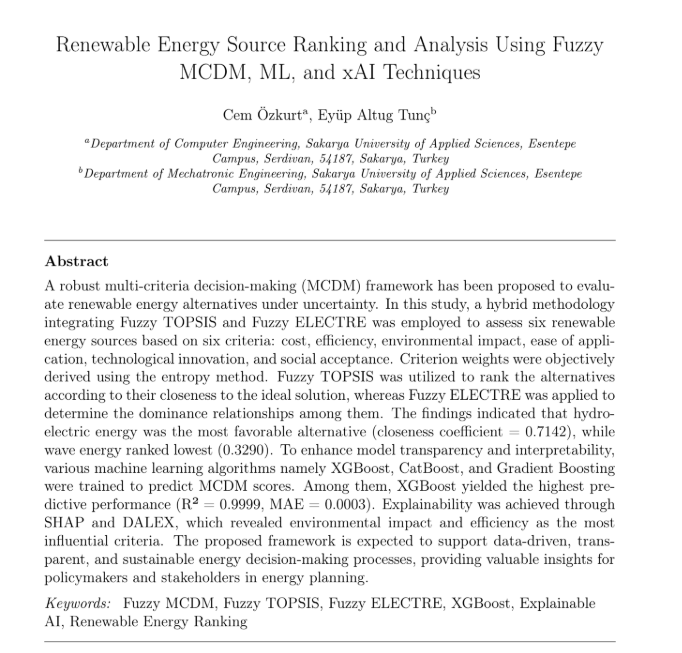
Renewable Energy Source Ranking and Analysis Using Fuzzy MCDM, ML, and xAI Techniques
Journal Article · 2025
Abstract: This research proposes a hybrid multi-criteria decision-making (MCDM) framework using Fuzzy TOPSIS and Fuzzy ELECTRE to evaluate renewable energy alternatives. XGBoost was found to be the most predictive model, with explainability provided by SHAP and DALEX.
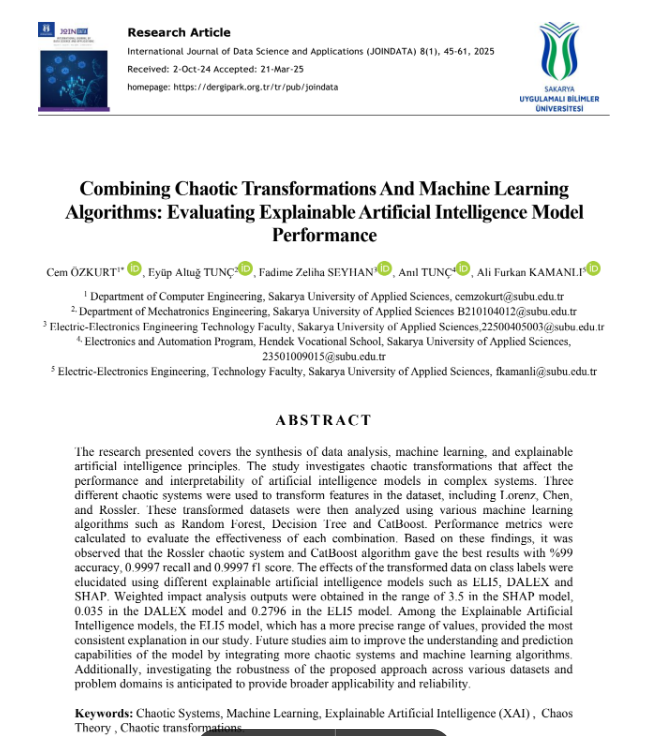
Combining Chaotic Transformations And Machine Learning Algorithms: Evaluating Explainable Artificial Intelligence Model Performance
JOINDATA 8(1), 45–61 · 2025
Abstract: This study investigates chaotic transformations that affect the performance and interpretability of AI models in complex systems. Results showed that Rossler chaotic system and CatBoost algorithm yielded 99% accuracy.
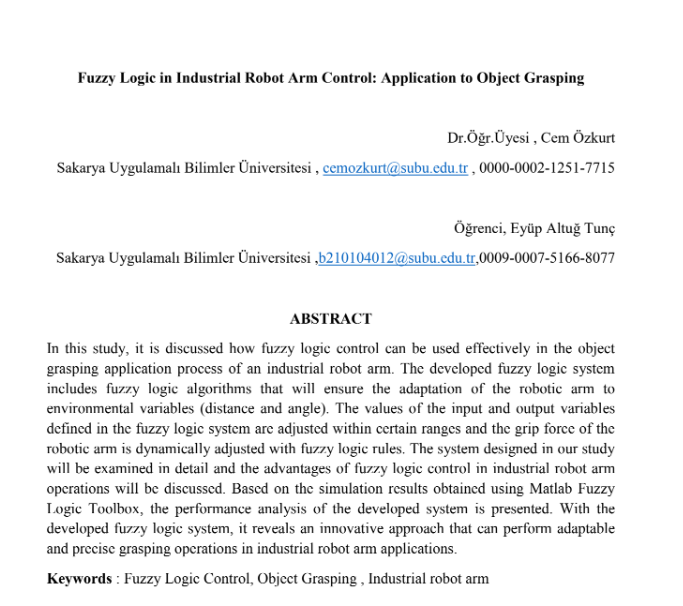
Fuzzy Logic in Industrial Robot Arm Control: Application to Object Grasping
Journal Article · 2024
Abstract: Discusses the effective use of fuzzy logic control to adapt a robotic arm to variables like distance and angle during object grasping.
Conference Papers
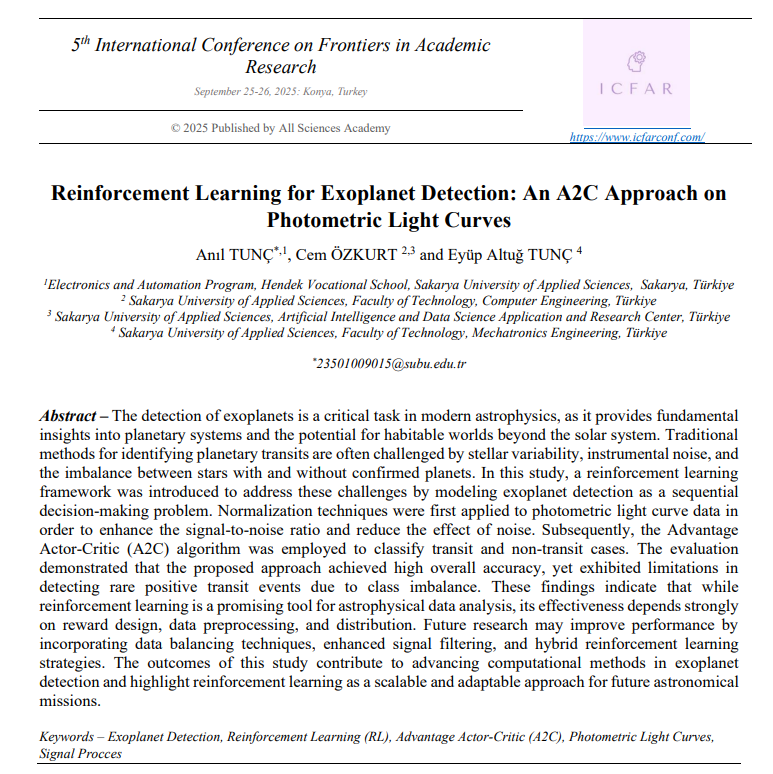
Reinforcement Learning for Exoplanet Detection: An A2C Approach on Photometric Light Curves
ICFAR 2025
Abstract: This study introduces a reinforcement learning framework for exoplanet detection, utilizing the Advantage Actor-Critic (A2C) algorithm to identify planetary transits in light curve data.
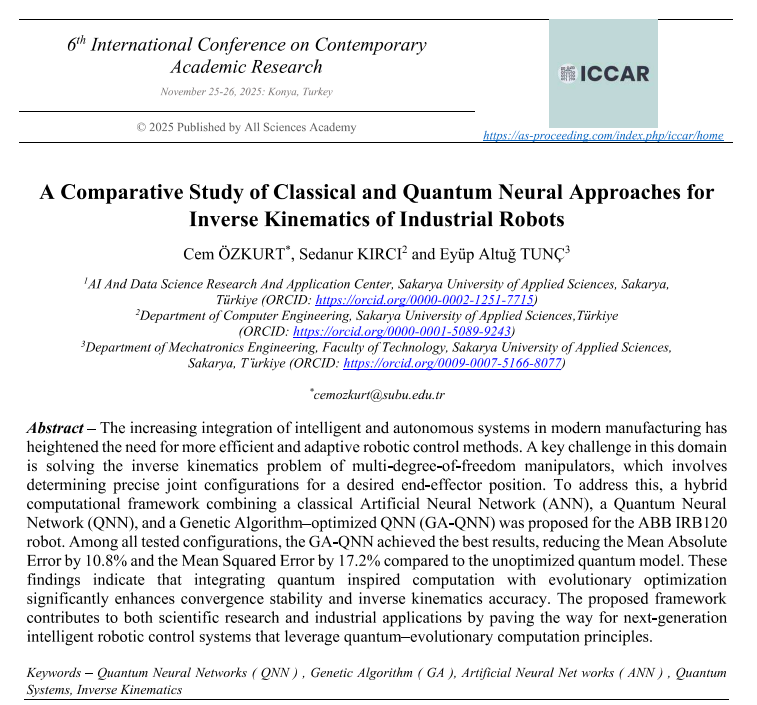
A Comparative Study of Classical and Quantum Neural Approaches for Inverse Kinematics of Industrial Robots
ICCAR 2025
Abstract: This research proposes a hybrid framework combining classical ANNs and Quantum Neural Networks (QNN) optimized by Genetic Algorithms for the inverse kinematics of industrial robots, achieving a 17.2% reduction in Mean Squared Error.
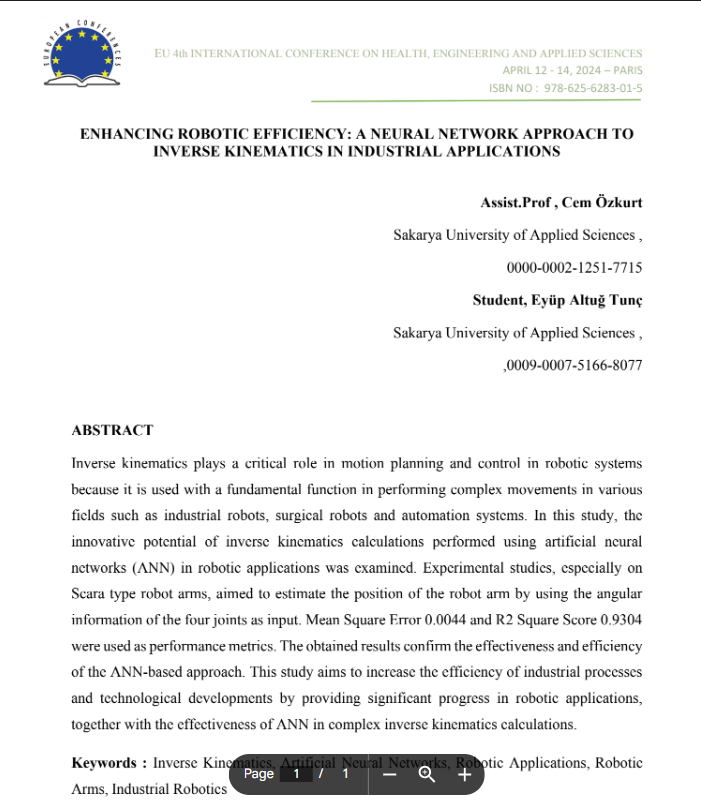
Enhancing Robotic Efficiency: A Neural Network Approach to Inverse Kinematics in Industrial Applications
EU 4th Int. Conference · Paris 2024
Abstract: Examined the potential of artificial neural networks (ANN) for calculating inverse kinematics of SCARA robot arms, achieving an R² score of 0.93.
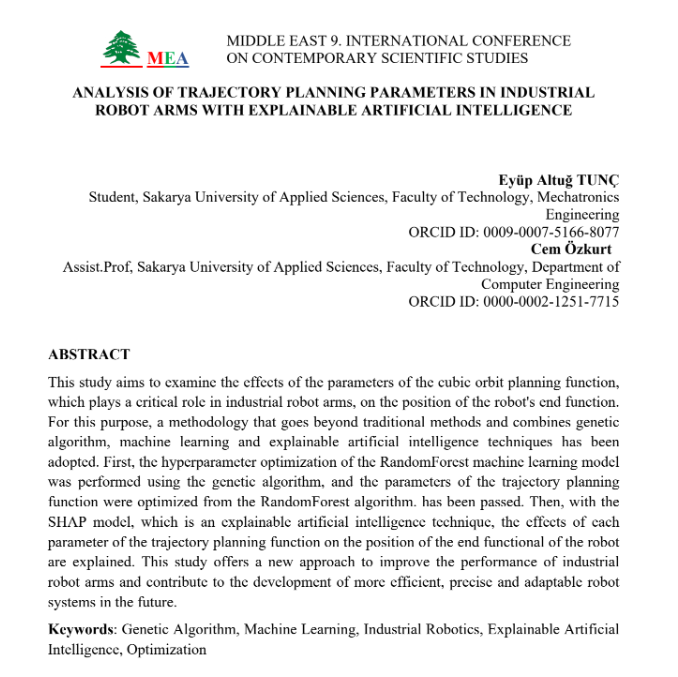
Analysis of Trajectory Planning Parameters in Industrial Robot Arms with Explainable Artificial Intelligence
Middle East 9th Int. Conference · 2024
Abstract: This study used genetic algorithms for hyperparameter optimization of RandomForest models, with trajectory parameters explained via SHAP.
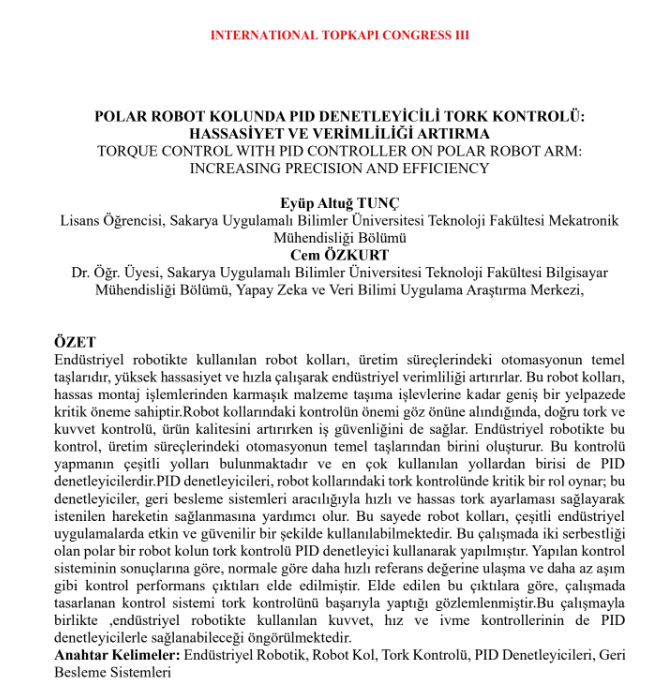
Torque Control with PID Controller on Polar Robot Arm: Increasing Precision and Efficiency
International Topkapi Congress III · 2024
Abstract: Implemented a PID-based torque control system for a 2-DOF polar robot arm, ensuring high precision and faster reference tracking.
Under Revision
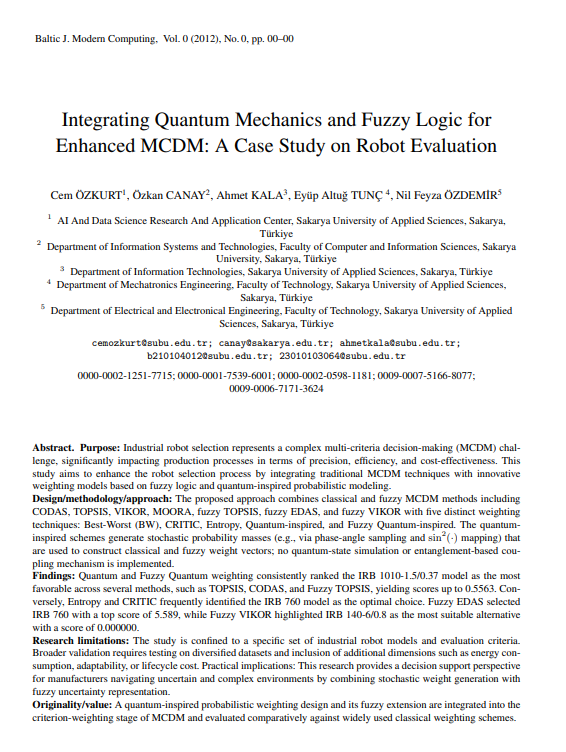
Integrating Quantum Mechanics and Fuzzy Logic for Enhanced MCDM: A Case Study on Robot Evaluation
Baltic J. Modern Computing · 2026
Abstract: This study aims to enhance the robot selection process by integrating traditional MCDM techniques with innovative weighting models based on fuzzy logic and quantum-inspired probabilistic modeling.
📝
Integrating Fuzzy Logic into Multi-Criteria Decision-Making for Industrial Robot Selection: A Comparative Evaluation
Under Revision · 2026
Manuscript currently under peer review for journal publication.